Solutions · Sustainability & ESG
Green Antiscalant Solutions: biodegradable membrane chemistry where the matrix allows
Biodegradability claims versus performance: jar tests, compatibility, and discharge constraints for your site.
Use this guide within its scope
This page supports technical research and option comparison and is marked 2026. Illustrative values are not a quotation, completed process design, certification conclusion, or performance guarantee. Check current regulations, feed data, tests, and OEM records.
Problem
Traditional polymers work but face scrutiny in sensitive discharge contexts.
Technology
Chemistry selection tied to LSI/silica reality—not label shopping.
Results
Maintained recovery with improved environmental profile where feasible.
Engineering decision card
Use when
Traditional polymers work but face scrutiny in sensitive discharge contexts.
Evaluate first
Chemistry selection tied to LSI/silica reality—not label shopping.
Inputs still required
Feed source and variability, capacity, target quality, operating hours, discharge or reuse boundary, available space, and utilities.
Comparison output
Maintained recovery with improved environmental profile where feasible. The final decision still needs feed data, mass balance, and any necessary testing.
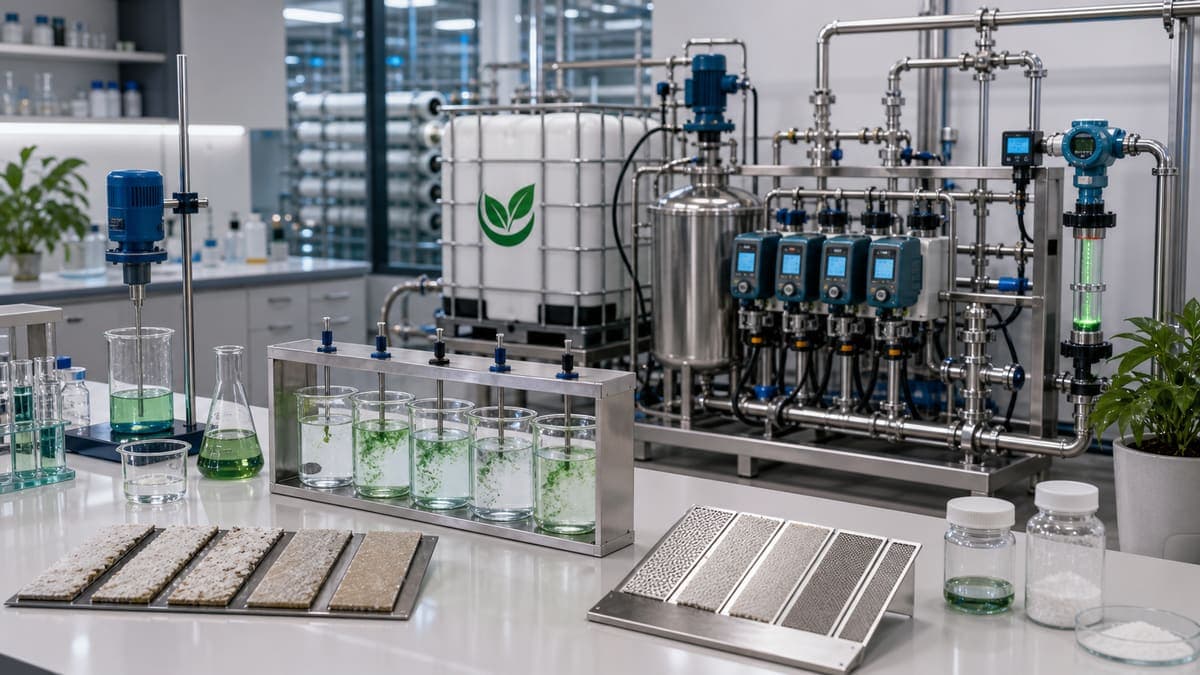
Green Antiscalant Solutions: biodegradable membrane chemistry where the matrix allows
The global industrial landscape faces converging pressures: the imperative to decarbonize, escalating water scarcity, and increasingly stringent environmental, social, and governance (ESG) expectations from investors and export markets. For UK and EU supply chains, these ESG gates are becoming non-negotiable. Effective water management, particularly in membrane-based purification, is no longer just about operational efficiency; it's a critical component of carbon footprint reduction and robust water risk mitigation. Green antiscalant solutions offer a strategic pathway to address these challenges, ensuring reliable water supply while minimizing environmental impact where the system's chemistry and operating conditions allow.
Membrane separation technologies—such as Reverse Osmosis (RO), Nanofiltration (NF), and Ultrafiltration (UF)—are cornerstones of industrial water treatment, enabling purification, reuse, and resource recovery. However, their efficiency is constantly threatened by scaling: the precipitation of sparingly soluble salts onto membrane surfaces. Uncontrolled scaling leads to increased operating pressure, reduced flux (flow rate), higher energy consumption, frequent cleaning cycles, and ultimately, premature membrane replacement.
Traditionally, antiscalants have relied on chemistries that, while effective, often present their own environmental burden. Many conventional formulations contain phosphorus, a nutrient that can contribute to eutrophication in receiving waters, or are recalcitrant (non-biodegradable), accumulating in the environment. As industries strive for 'Net Zero' and 'Circular Economy' principles, the chemical footprint of every process input, including antiscalants, comes under scrutiny.
Biodegradable antiscalant solutions represent a significant step forward. These advanced chemistries are designed to break down into benign components in the environment, mitigating concerns around persistent organic pollutants and nutrient loading. This translates directly into better discharge water quality, reducing the burden on wastewater treatment plants and easing compliance with stricter effluent regulations—a particularly critical factor for international industrial buyers and EPCs operating within or exporting to the environmentally-conscious UK and EU markets. By choosing biodegradable options, businesses can directly contribute to their carbon reduction targets (e.g., through reduced chemical manufacturing and transport impacts) and bolster their water stewardship credentials, thereby enhancing their market access and competitive edge.
Worked energy / carbon sketch
One of the direct benefits of superior antiscalant performance, particularly from optimized green chemistries, is the sustained operational efficiency of membrane systems. Scaling leads to increased trans-membrane pressure (TMP) to maintain flux, or a decrease in flux at constant pressure. Both scenarios increase specific energy consumption.
Let's consider an illustrative industrial Reverse Osmosis (RO) plant operating 24/7.
-
Assumptions:
- RO system processes 1,000 m³/day (approx. 41.7 m³/hour).
- Operating 8,000 hours/year.
- Average specific energy consumption with traditional antiscalant due to fouling pressure creep: 1.3 kWh/m³.
- Average specific energy consumption with optimized green antiscalant (maintaining better membrane performance, delaying pressure creep): 1.25 kWh/m³. This represents a plausible 3.8% improvement.
- Grid electricity carbon intensity factor for industrial users (illustrative UK 2026 estimate): 0.18 kg CO₂e/kWh.
-
Calculation:
- Annual water treated: 1,000 m³/day * (8,000 hours/year / (24 hours/day)) = 333,333 m³/year (approx.)
- Annual energy consumption (traditional): 333,333 m³/year * 1.3 kWh/m³ = 433,333 kWh/year
- Annual energy consumption (green antiscalant): 333,333 m³/year * 1.25 kWh/m³ = 416,666 kWh/year
- Annual energy savings: 433,333 kWh/year - 416,666 kWh/year = 16,667 kWh/year
- Annual carbon savings: 16,667 kWh/year * 0.18 kg CO₂e/kWh = 3,000 kg CO₂e/year = 3.0 tonnes CO₂e/year
This back-of-envelope calculation illustrates how even a small percentage improvement in specific energy consumption, driven by more effective and environmentally sound chemical treatment, translates into tangible carbon footprint reductions. Further savings can be realised through reduced chemical manufacturing/transport emissions and less frequent membrane replacement.
Traditional vs engineering evaluation path
| Topic | Legacy polymer antiscalant | Greener chemistry (engineering evaluation path, where matrix allows) |
|---|---|---|
| Discharge | P/COD load can complicate sensitive permits. | Biodegradability profile aligned to site effluent rules—still needs jar proof. |
| Membrane life | Recovery pushed until aggressive CIP. | Aim: same LSI/silica guard with fewer CIP events and lower kg chemical/m³. |
| Proof | “It worked last year.” | Logged dose, SEC, and ΔP trend tied to disclosure. |
The journey toward comprehensive water stewardship involves more than just selecting the right chemistry; it requires robust data collection and transparent reporting. Metering key parameters such as water flow, energy consumption, and chemical dosages, combined with accurate mass and energy balance calculations, forms the bedrock of credible ESG disclosure. This data, rigorously documented and verified, directly supports responses to major ESG questionnaires like CDP Water Security and the Alliance for Water Stewardship (AWS) standard. By demonstrating a proactive approach to optimizing resource efficiency and minimizing environmental impact through tangible, verifiable metrics, companies can build trust with stakeholders, meet export market requirements, and safeguard their social license to operate—without over-claiming or resorting to greenwashing.
FAQ
Q1: What does "where the matrix allows" mean for biodegradable antiscalants? A1: It refers to the specific water chemistry, temperature, membrane type, and operating conditions of your system. While biodegradable chemistries are highly advanced, some extreme industrial conditions (e.g., very high saturation indices, specific organic foulants) may still necessitate conventional or blended approaches. this approach conducts thorough water analysis to recommend the optimal solution, balancing performance with environmental impact.
Q2: Are biodegradable antiscalants as effective as traditional ones? A2: Modern biodegradable antiscalants are designed for high efficacy. Many surpass traditional formulations in specific applications, offering superior scale inhibition, dispersion, and iron chelation properties while ensuring environmental compatibility. Our selection process prioritizes performance alongside biodegradability to ensure your membrane systems remain protected.
Q3: Is there a cost premium for green antiscalant solutions? A3: While the unit cost of some biodegradable antiscalants might sometimes be marginally higher, the total cost of ownership (TCO) is often lower. This is due to benefits such as reduced dosage, extended membrane life, fewer CIP cycles (saving energy, water, and chemicals), lower disposal costs for effluent, and enhanced brand reputation through improved ESG metrics.
Carbon savings calculator (illustrative)
Estimate annual electricity savings and avoided CO₂e when specific energy improves (e.g. after ERD, VFD tuning, or train optimization). Replace defaults with your meter data and your grid emission factor from your utility or ESG methodology.
ΔkWh/year ≈ Q(m³/h) × hours/year × (kWh/m³before − kWh/m³after) · tCO₂e ≈ ΔkWh × factor / 1000
Δ specific energy: 1.00 kWh/m³
Estimated electricity savings: 800,000 kWh/year
Indicative avoided emissions: 336 tCO₂e/year
Related equipment & product lines
These categories typically support the approach above—open any line to compare brands and models.
- ChemicalsAntiscalants, cleaners, and process chemicals for water treatment operations.View category →
- RO MembranesReverse osmosis membrane elements for municipal and industrial desalination.View category →
- Replacement Parts / SparesGeneral replacement parts for treatment systems and subassemblies.View category →
For a closer review, use the engineering inquiry form to share feed, capacity, target, and project stage. Submission does not constitute a completed design or performance commitment.